
Hello to everyone reading this on Fastmath.io. My name is Thammathon Noisanga. I am a competitor, coach, and developer of the mental arithmetic website Otaku_Kidlek.
When building mental arithmetic equations, many people focus on formulas. But another skill is just as important: using up leftover numbers. You may know a useful formula, only to find that it leaves one to three digits unused. Mental arithmetic rules clearly state that every randomly drawn digit must be used, with none missing and none added. If you cannot incorporate the remaining digits, your equation still breaks the rules. In this article, I will explain the techniques I use, so teachers and fellow players can include them in their practice.
There are four common approaches.
1. Using up a 2 or 4
To incorporate an extra 2 or 4, use square roots.
For example: 2 2 8 6 → 58
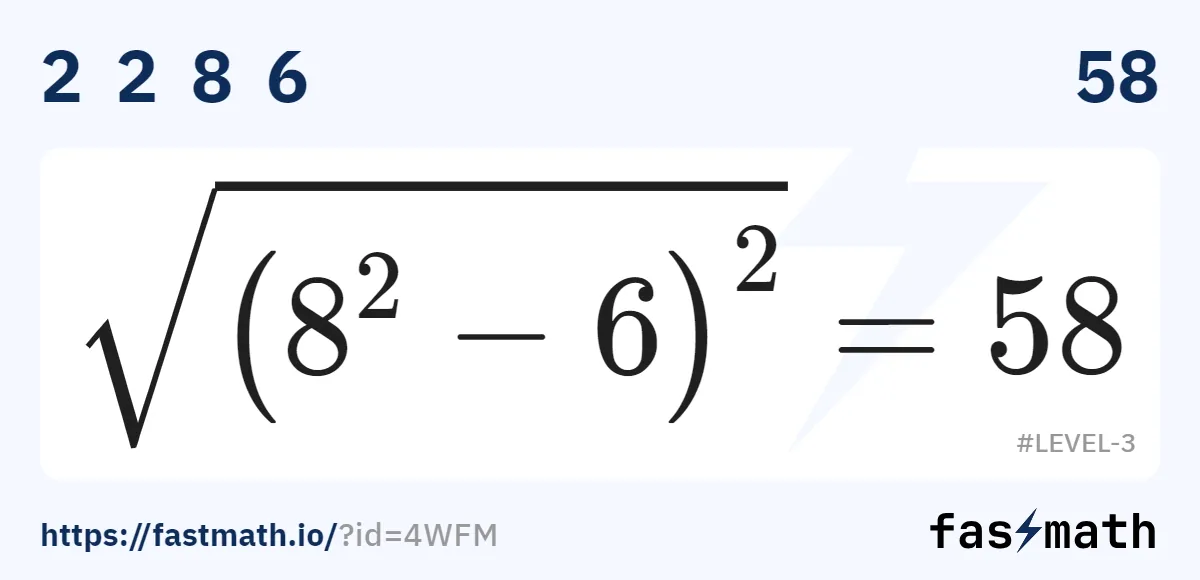
The expression already gives the target, 58, but leaves one 2 unused. We can use that 2 as an exponent and then take the square root. This incorporates the remaining digit without changing the answer.
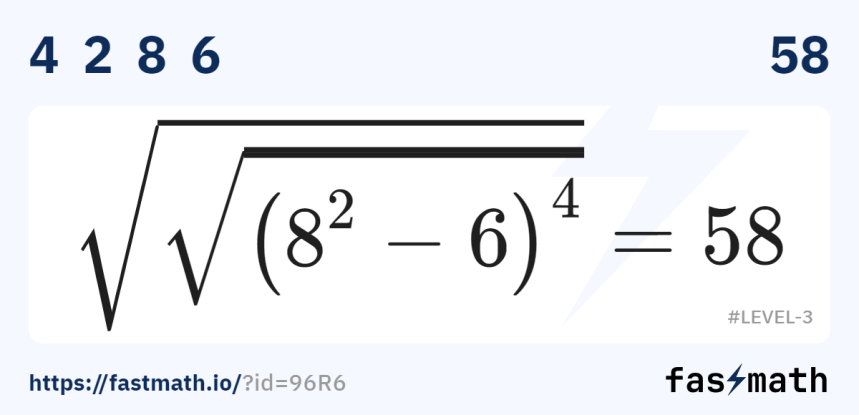
If the leftover digit is 4, add another square root, giving two nested roots.
For example: 4 2 8 6 → 58
2. Using zero to absorb other digits
If the question contains a zero, one of the best ways to use up leftover numbers is to multiply them by zero.
For example: 0 7 8 4 → 33
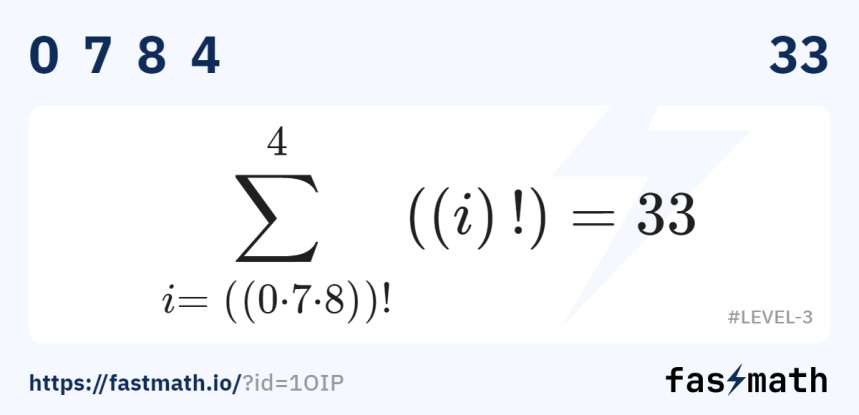
Here, only 0 and 4 are needed to produce 33, leaving 7 and 8. Because the question includes 0, we can multiply both remaining digits by it, then apply a factorial as shown above.
3. Using one to absorb other digits
This is similar to using zero, but instead we place the leftover numbers in the exponent of 1.
For example: 5 7 1 4 → 95
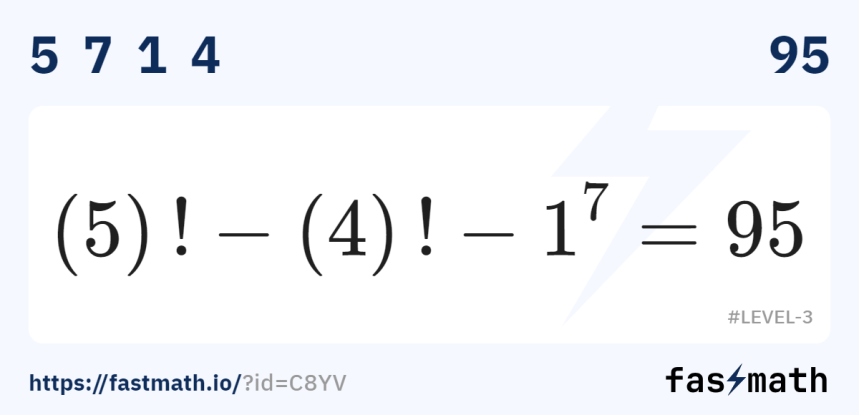
The expression already gives the target, 95, but leaves 7 unused. We can incorporate it by using it as the exponent of 1, as shown above.
4. Using the next integer, n, to absorb n − 1
Perhaps you have a 4 and need to use up a 3, or a 6 and need to use up a 5. In other words, you have and want to incorporate . This final technique is as common as the previous three, but works differently. Instead of relying on the individual number’s properties, it uses factorials. If you have 5 and 6 but only need the value 6, none of the earlier techniques directly absorbs the 5. Instead, use the identity .
For example: 7 8 6 5 → 62
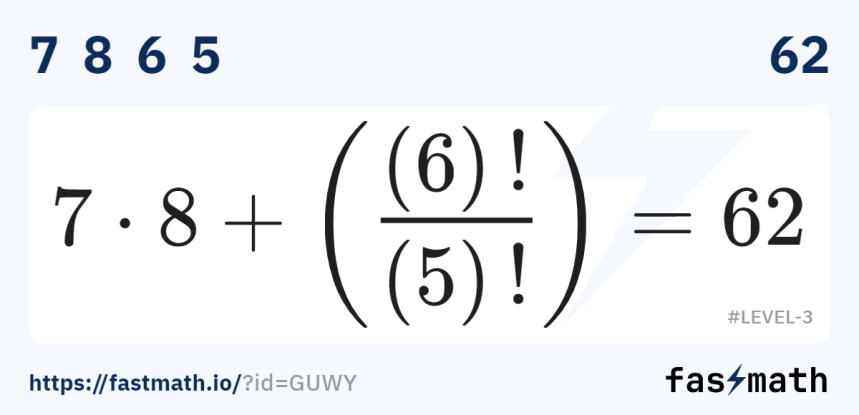
The expression gives the target, 62, but leaves 5. Look for a number one greater than 5, or : here, it is 6. Apply a factorial to both numbers, then divide the larger result by the smaller. This incorporates the leftover number, as shown above.
That concludes this introduction to using up digits when an equation leaves some unused. In future articles, I may share how I look at numbers during competitions and how I build and adapt formulas. You can follow all of these articles on Fastmath.io. See you next time!